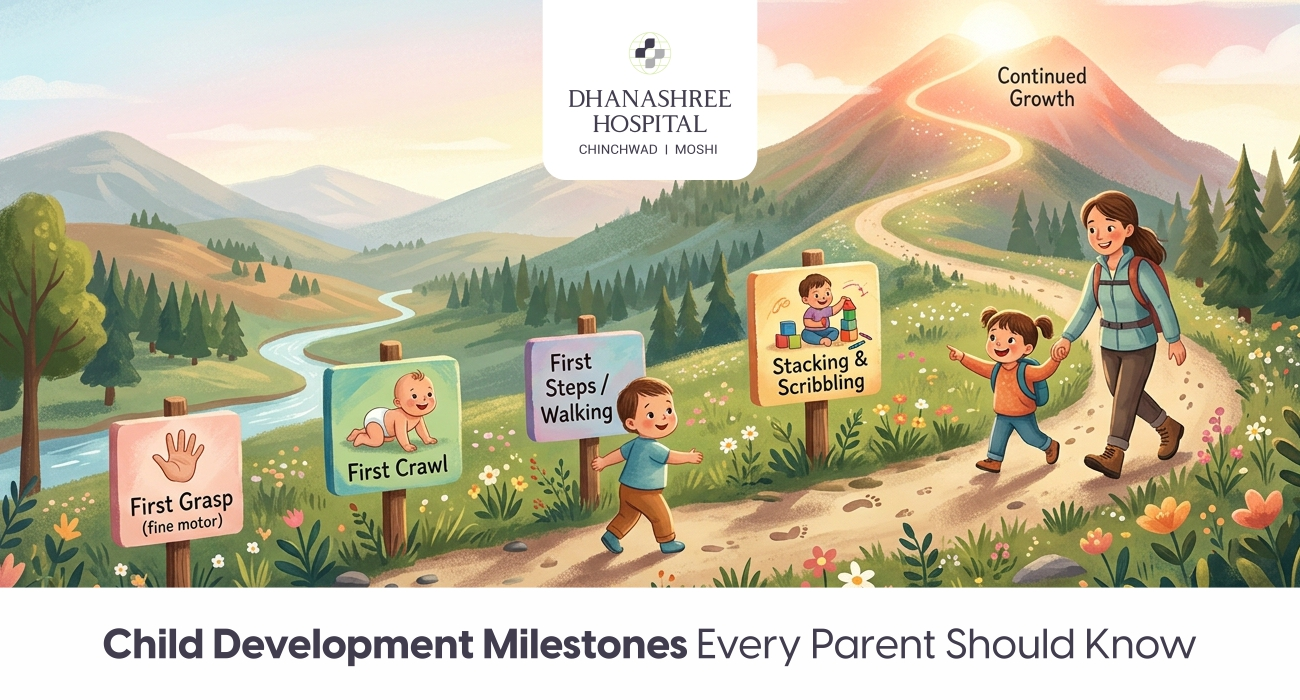
Every child grows at their own pace, but certain developmental milestones offer important clues about healthy physical, cognitive, social, and emotional progress. Understanding these milestones helps parents recognise early strengths, identify possible delays, and seek timely care when needed. At Dhanashree Hospital, our Pediatrics Department focus on complete developmental monitoring designed to support your child during the earliest and most crucial years of growth.
Responds to voices and sounds Why it matters: These early interactions show emotional connection and healthy neurological development. If you ever feel unsure about your baby’s responsiveness, the Neonatal Care team can help assess early behaviour.
2. Babbling & Sound Exploration (4–6 Months)
Makes consonant sounds like ba, ma, da
Responds to tone of voice
Starts mimicking sounds Why it matters: This is the foundation of speech and language learning.
3. Reaching, Grasping & Hand Movements (4–6 Months)
Grasps toys
Reaches for objects
Transfers items between hands Why it matters: These movements indicate motor skill development and hand–eye coordination.
4. Rolling Over (4–7 Months)
Rolls from tummy to back and later back to tummy
Shows improved muscle strength Why it matters: Rolling is a major mobility milestone and a sign of developing core stability.
5. Sitting Without Support (6–8 Months)
Sits independently
Maintains posture
Uses hands freely while sitting Why it matters: Sitting upright allows better exploration, learning, and visual engagement.
6. Crawling or Moving Independently (7–10 Months)
Crawls, scoots, or shuffles
Explores the environment
Builds curiosity and independence Why it matters: Crawling develops coordination between both sides of the body, essential for later skills like writing.
7. Standing & First Steps (9–12 Months)
Pulls up to a standing position
Stands with support
May take first steps Why it matters: These actions mark major muscular and bone growth, balance, and confidence.
If your child seems slow to bear weight or walk, an evaluation at our Orthopaedic Department can help.
8. First Words & Communication (10–14 Months)
Says simple words like “mama”, “dada”, “bye”
Tries to imitate words Why it matters: These are early signs of expressive language development.
Points to objects when named Why it matters: Shows increasing cognitive processing, attention, and communication skills.
10. Play, Imitation & Social Interaction (1–2 Years)
Plays simple games
Imitates household activities
Shows interest in other children Why it matters: These behaviours reflect emotional growth, imagination, and early social skills.
When Should Parents Be Concerned?
Seek a pediatric consultation if you notice:
No response to sound or name
Not sitting by 9 months
No words by 15–18 months
Persistent stiffness or floppiness
Loss of previously learned skills
No eye contact or smiling
Not walking by 18 months
Your child’s doctor may recommend further evaluation through the Diagnostics Department, including developmental assessments or neurological screening if needed.
Every child progresses differently, but understanding developmental milestones helps parents stay aware and confident. Early recognition of delays ensures timely support and better long-term outcomes. If you have any concerns about your child’s development, behaviour, or physical milestones, our pediatric specialists are here to guide you every step of the way.
If you’d like to monitor your child’s development, schedule a consultation with our pediatric experts. Book an appointment today.
Frequently Asked Questions
Key milestones include smiling, babbling, rolling over, sitting without support, crawling, standing, and beginning to speak simple words.
Most babies begin crawling between 7–10 months, but some may scoot or shuffle instead. Any form of mobility is usually normal.
If your child is not saying simple words like mama or dada by 15–18 months, you should consult a pediatrician for a developmental evaluation.
If your child is not walking independently by 18 months, a pediatric check and possibly an orthopaedic or physiotherapy assessment is recommended.
Not always. Many delays improve significantly with early intervention, therapy, and guided developmental support.
Encourage tummy time, interactive play, reading, music, responding to sounds, and offering safe mobility opportunities to strengthen skills.
Yes. Hearing loss can impact babbling, speech clarity, and language development. Early ENT evaluation helps rule out underlying concerns.
If you notice loss of skills, lack of response to sound or visual cues, extreme stiffness/floppiness, or delayed milestones across multiple areas, a specialist evaluation is advisable.